Should Coaches Run a Client Referral Program
A coach with a full practice asked me this summer whether he should build a referral program. He already got referrals. What he wanted was a way to produce them on purpose instead of by accident, which is a reasonable thing to want. The trouble is that almost everything published on the subject was written for a company selling a forty dollar product to a hundred thousand customers, and very little of it survives contact with a thirty thousand dollar coaching offer.
What a Client Referral Program Actually Is
A client referral program is a standing arrangement that tells the people who already trust you who you want to meet, how to make the introduction, and what happens after they do. It is a documented process rather than a hopeful ask. The reward attached to it can be money, and in a high ticket practice it usually should not be.
That last sentence is the argument of this whole post, so I will spend the rest of it earning the claim.
When Formalizing Too Early Backfires
Most coaches who ask me about a program are trying to solve a volume problem with a structure problem.
If you have delivered a result for eleven people, you do not have a referral program problem. You have a sample size problem, and the fix is another season of good work and a habit of asking well. A program adds terms, rewards, tracking and a page on your site. None of that manufactures the thing a referral runs on, which is somebody being willing to attach their name to yours in front of a person they care about.
There is a second reason to wait, and it is the one nobody says out loud. A formal program changes what your clients think you are doing when you ask. An unprompted recommendation carries the weight it carries precisely because there is nothing in it for the person making it. The moment there is, the recommendation is a different object, and everyone involved knows it.
So the honest sequence is get results, ask directly, watch what happens, and only then decide whether the pattern is worth writing down. The asking conversation is its own skill and it is where I would start.
What Goes In a Program That Fits a High Ticket Practice
If you have passed that bar, here is the whole thing. It is shorter than the templates suggest.
Who Is Eligible to Refer
Decide this before anything else, because it determines the quality of everything downstream.
My answer is narrow. Current clients who have finished a phase and can describe the result in a sentence, past clients who got something they still talk about, and practitioners who serve the same person immediately before or after you do. Not your audience. Not everyone on your list. An open program invites volume, and volume is the wrong goal when your close conversation takes six weeks.
What the Referrer Gets
Rank the options in this order. Access first, because introducing someone to a room they wanted to be in is worth more to a peer than a check. Reciprocity second, meaning you send business back, deliberately and soon. Recognition third. Money last, and only where the referrer is not the kind of person the first three reach.
The reason for the order is that the first three deepen the relationship and the fourth prices it.
How You Keep Track
Write down who sent whom, what happened, and what you owe back. That is the entire requirement, and a spreadsheet does it.
The reason to bother is not reporting. It is that unmanaged imbalance is what quietly kills referral relationships. Somebody gives more than they get for eight months, nobody notices, and then they stop. Set up the tracking before you need it, because you cannot reconstruct a year of goodwill from memory.
How Much You Should Offer
Less than the internet tells you, and often nothing.
The percentages you see quoted come from real estate, insurance and mortgage, where a referral is a licensed handoff of a regulated transaction. Coaching is not that, and borrowing the number borrows the wrong model with it.
There is research worth reading before you pick a figure. Work co-authored by Yale School of Management's Aniko Ory on how companies fuel word of mouth found that referral bonuses and free tiers can each be effective depending on the size of the audience and whether the offering has a social dimension. Hold your own practice against those two conditions. Your audience is small on purpose and a coaching decision is a private one, not a social one, which is exactly the setting where a bonus does the least work for the money.
What I Do Instead Inside a Curated Room
I run the alternative rather than the program, so I will describe it as mine, not as advice.
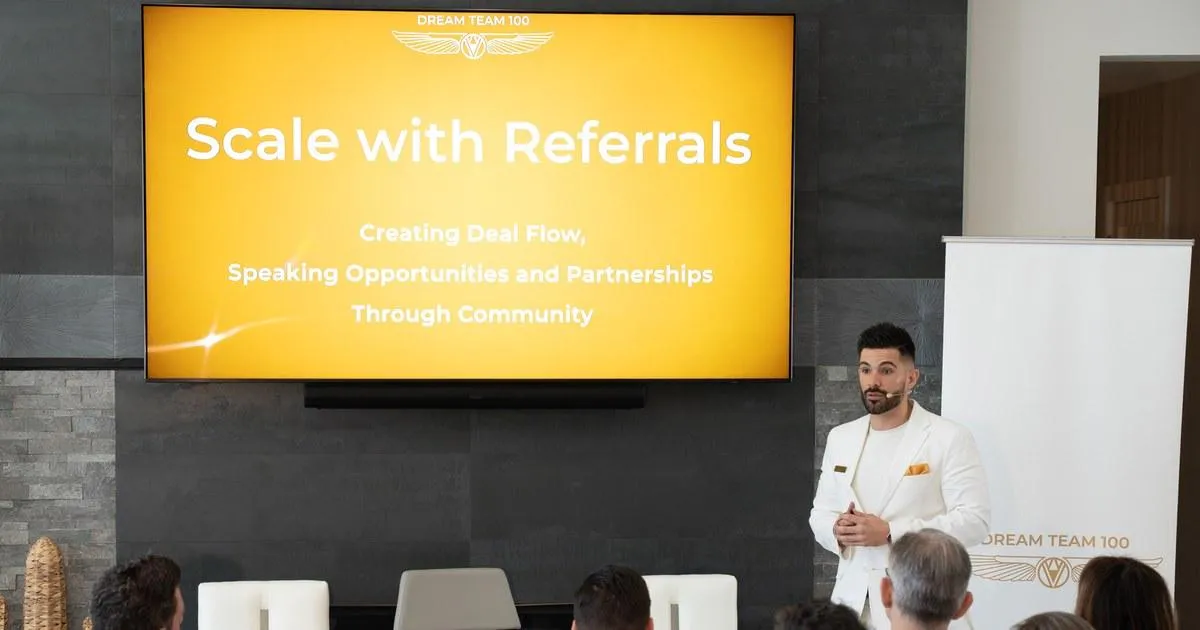
Dream Team 100 admits one expert per niche and caps membership at a hundred people. Those two rules do the job a commission is usually hired to do. Nobody in the room competes with anybody else for the same client, so introducing a peer costs nothing and withholding one buys nothing. There is no fee to disclose because there is no fee, and the incentive is structural. At a thirty thousand dollar seat, one new client pays for the year, which means members refer because being referred back is the return on the membership itself.
The community's own collective figure for what that has produced is $15M+ via referral systems, published on Sebastian's own page and cited here as the community's claim rather than a projection for anyone reading.
That model is not available to everyone and it is not supposed to be. If you are building alone, the wider referral strategy is the place to start, and a practice that runs on referrals looks different from one that bolts a program onto ads.
If you would rather be in a room where the structure does this for you, check whether your niche is still open and book a call. Niches already claimed have a waitlist.
FAQ on Client Referral Programs
What is a client referral?
A client referral is an introduction to a specific person, made by someone who has worked with you, to someone they believe you can help. The word covers both the unprompted recommendation and the deliberate handoff, and the difference between those two matters more than most programs account for.
Can you give me an example of a referral program?
A workable one at this price point reads like this. Current and recent clients may refer. They send one named person with a sentence about why. I reply within a day, tell the referrer what happened either way, and look for something to send back. There is no fee and no code.
How to run a referral program?
Decide who may refer, decide what they get, tell them plainly, and keep a record of what came from whom. Then do the part that is actually hard, which is closing the loop every single time. Almost nobody does, and it is the cheapest way to earn a second referral from the same person.